Why a Local Shop Beats the Big Chains for Tire and Auto Work

We’re not going to pretend the big chains don’t do good work. A lot of them do. They’ve got brand recognition, they’ve got financing options, and they’ve got locations in every town. There’s a reason they’re as big as they are.

But here’s something we’ve noticed after almost two decades of fixing cars in the Treasure Valley. The people who walk into our shop after years of going to a chain almost always tell us the same things. They felt rushed. They got told they needed work they weren’t sure they actually needed. The estimate kept growing. They never saw the same technician twice. By the end of it, they didn’t really trust the answers they were getting.

That’s not a coincidence. It’s structural. And it’s why local shops still matter.

The Quota Problem

Most national chains operate on quotas. Service writers have targets to hit. Technicians get paid in part based on how many billable hours they generate. The math of the business depends on selling you something every time you walk in.

That doesn’t make every chain technician dishonest. Plenty of them are great. But the pressure to upsell is baked into the system, and it shows up in subtle ways. The brake pads “should probably be done now even though they have life left.” The cabin air filter “is due.” The wiper blades that were fine three months ago suddenly need replacing.

At a local shop, none of that pressure exists in the same way. We make money when you trust us enough to come back. That changes how we approach every conversation.

You Get the Same Faces

Walk into our shop on a Tuesday and you’ll see Nick, Donny, and Miguel. Walk in next month and you’ll see Nick, Donny, and Miguel. That continuity matters more than it sounds like it should.

When the same people work on your car over time, they remember it. They remember that the alignment was off when you brought it in last year. They remember that you mentioned a clunk in the front end that turned out to be a sway bar link. They notice when something looks different from last time. That kind of pattern recognition is what catches problems early.

At a chain, you’re starting from zero every visit. Whoever pulls the work order is meeting your car for the first time.

We Actually Know the Roads You Drive

If you live in the Valley, your car deals with specific things. Hot summers that bake tires. Cold winter mornings that stiffen rubber. Gravel from the canals. Goathead thorns. Trips up to McCall and Tamarack that put real load on brakes. Long stretches of I-84 at speed.

A national chain trains its technicians on national standards. We’ve been working on Treasure Valley cars since 2007. We know what tends to go wrong on a truck that spends its weekends in the Owyhees. We know what kind of tire wear to look for on a sedan that mostly commutes between Nampa and Boise. That local context shows up in the recommendations you get.

Honest Diagnostics

This is the part we hear about most. A customer comes in worried about brakes because another shop told them they needed all four corners done plus rotors. We pull the wheels, take a look, and tell them their fronts are at 60 percent and the rears are at 70 percent. They have a year of driving left.

Sometimes the other shop was right and we confirm it. But when they weren’t right, it’s our job to say so. We’d rather lose a sale and gain a customer for life than the other way around.

What Local Doesn’t Mean

Local doesn’t mean amateur. Our team is certified, our equipment is current, and we work on everything from daily drivers to lifted trucks to custom builds. Local also doesn’t mean expensive. Our pricing is competitive with the chains on tires, and often noticeably better on labor.

What local means is accountability. If something isn’t right, you know exactly who to talk to. If you have a question a week later, you can call and get an answer from the person who actually did the work. If you want to know why something costs what it costs, you’ll get a real explanation.

Try Us Once

That’s all we ask. Bring your car in for a free tire check, an oil change, a brake inspection, whatever you’d normally take to a chain. See how the conversation goes. See whether what we tell you matches what you expected. Most people who try us once don’t go back.

Schedule a visit or call (208) 559-8492. We’re at 19945 Middleton Road in Caldwell, and walk-ins are always welcome.

5 Signs Your Brakes Need Service (And Why Waiting Costs More)

Brakes are the one system on your car you never want to find out is broken at the wrong moment. The good news is that brakes almost always give you warning signs before they fail completely. The bad news is that those signs are easy to ignore until you’re suddenly looking at a much bigger repair bill, or worse.

Here are the five signs to watch for, and what’s actually happening when you notice them.

1. Squealing or Squeaking When You Brake

That high-pitched squeal you hear when you press the brake pedal is usually caused by a small metal tab built into your brake pads, called a wear indicator. It’s designed to scrape against the rotor once your pads get thin enough, and it makes that noise on purpose to tell you it’s time for new pads.

If you catch it at the squealing stage, you’re in good shape. Replacing pads is a straightforward, affordable job. Ignore it for too long, and the pads wear through completely.

2. Grinding When You Brake

Grinding is what squealing turns into when you wait too long. At this point, the pads are gone and you’re pressing metal against metal every time you stop. Each stop is now gouging into your rotors, and what would have been a pad replacement is now a pad and rotor replacement. Sometimes a caliper repair too, if the damage has spread.

If your brakes are grinding, stop driving the car if you can and get it looked at right away. Every stop is making the damage worse.

3. The Car Pulls to One Side When Stopping

If your car drifts left or right when you press the brake pedal, one side of your braking system is doing more work than the other. Common causes include:

  • A stuck caliper
  • A collapsed brake hose
  • Uneven pad wear
  • Air or water in the brake lines

This is more than an inconvenience. Uneven braking means longer stopping distances and a car that doesn’t behave predictably in an emergency. It’s worth getting checked promptly.

4. Vibration or Pulsing in the Brake Pedal

If you feel the brake pedal pulse back against your foot when you stop, especially at highway speeds, your rotors are probably warped. Rotors can warp from heat (think long mountain descents with the brakes riding), from uneven wear, or from a wheel torque that was too tight.

In some cases, the rotors can be resurfaced (machined down to a flat surface again). In others, they need to be replaced. Either way, the longer you drive on warped rotors, the more it wears on your pads and the more the vibration spreads to other suspension components.

5. The Brake Pedal Feels Wrong

This one’s harder to describe, but you know your car. If the pedal feels softer than usual, or it travels farther before catching, or it feels spongy in a way it didn’t before, something is changing in the hydraulic system. Common causes include:

  • Low brake fluid
  • A leak in a brake line
  • Air in the lines
  • A failing master cylinder

A soft pedal is one of the more serious warning signs because it points to a problem with the system that actually transmits force to your brakes. Don’t wait on this one.

Why Waiting Costs More

Brake problems compound. A worn pad is a $200 repair. The same problem ignored for a few months becomes a $500 repair when it takes the rotor with it. Ignored longer, and you can damage the caliper, the hub, or worse, end up in an accident because you couldn’t stop in time.

Brake work isn’t where you want to save money by waiting.

What to Expect at 208 Tire

A brake inspection at our shop is straightforward. We pull the wheels, measure your pad thickness, check your rotors for wear and warping, inspect the hoses and lines, and check your brake fluid. Then we tell you what we found and what your options are.

Sometimes the answer is “your brakes are fine, see you in 10,000 miles.” Sometimes it’s “you’ve got time, but plan on pads in the next few months.” And sometimes it’s “you need this taken care of this week.” Either way, you’ll know exactly where you stand.

Schedule a brake inspection or call (208) 559-8492. We serve Caldwell, Nampa, Meridian, Eagle, and the rest of the Treasure Valley.

Winter Tires vs. All-Season: What Idaho Drivers Really Need

Every fall, the same question comes through the shop. “Do I really need winter tires, or are all-seasons fine?” It’s a fair question. Winter tires aren’t cheap, and the Treasure Valley doesn’t get the same kind of winters that Coeur d’Alene or Stanley deal with. So the answer depends on where you actually drive.

Here’s how to think about it.

What All-Season Tires Are Actually Built For

The name “all-season” is a little misleading. All-season tires are really three-season tires that can handle light winter conditions. They use a rubber compound that stays flexible in moderate temperatures and a tread pattern designed to balance dry grip, wet grip, and a little bit of light snow capability.

In the Valley floor, where most winters are mostly wet with occasional snow that melts within a few days, a good set of all-seasons will get most drivers through just fine. If you mostly drive between home, work, and the grocery store, and you can wait out the worst storms, all-seasons usually do the job.

Where All-Season Tires Run Out of Grip

The rubber compound in all-season tires hardens up once temperatures drop below about 45 degrees. When that happens, the tire loses traction even on dry pavement, and the difference on snow and ice is dramatic. That’s the part most drivers don’t realize. It’s not just about the tread pattern. It’s about the rubber itself.

If any of the following describe your driving, all-seasons probably aren’t enough:

  • You commute up to Bogus Basin or ski regularly at Tamarack or Brundage
  • You drive Highway 55 or Highway 21 in the winter
  • You head to McCall, Cascade, or Donnelly during the season
  • Your job requires you to be on the road regardless of weather
  • You live somewhere in the foothills where the roads stay icy longer

In those cases, winter tires aren’t a luxury. They’re the difference between getting up the hill and sliding back down it.

What Winter Tires Actually Do Differently

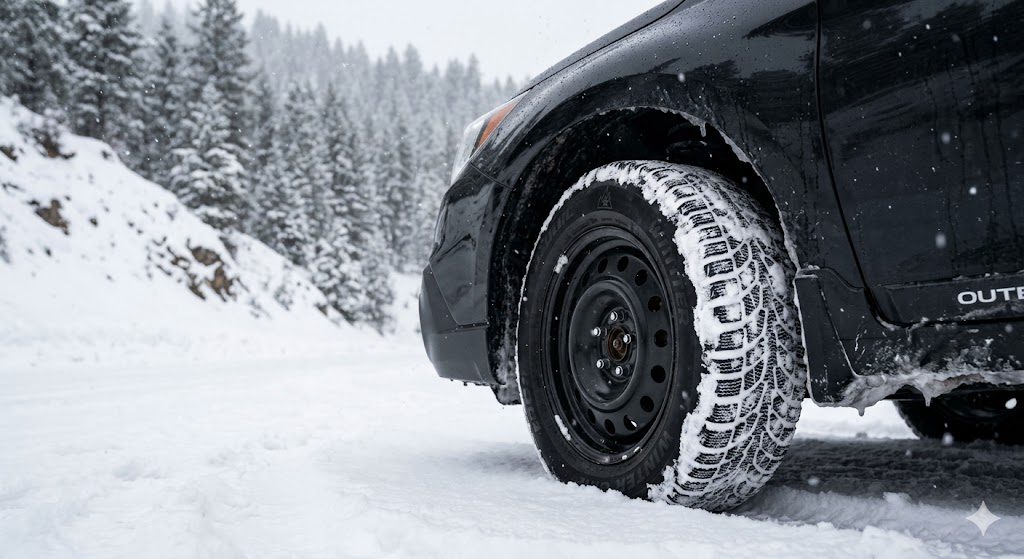
A real winter tire (look for the three-peak mountain snowflake symbol on the sidewall) does three things that all-seasons can’t:

  1. Stays soft in the cold. The rubber compound is designed to remain flexible at temperatures well below freezing, which keeps the tire gripping the road.
  2. Bites into snow and ice. Deep tread blocks and tiny slits called sipes give the tire hundreds of biting edges that grab loose snow and slush.
  3. Channels slush away. Aggressive grooves push water and slush out from under the tire so it can actually contact the road.

The difference shows up most in stopping distance. On packed snow, a winter tire can stop your car 30 to 40 feet shorter than an all-season at 30 mph. That’s the length of a small car. Sometimes that’s the difference between a near miss and a fender bender.

What About “All-Weather” Tires?

This is a newer category that’s worth knowing about. All-weather tires carry the three-peak mountain snowflake symbol like a winter tire, but they’re designed to be run year-round. They’re a real upgrade over standard all-seasons if you don’t want to deal with swapping tires twice a year, and they’re a good fit for a lot of Treasure Valley drivers.

The tradeoff is that they wear faster in summer heat than a true summer or all-season tire, so they’re not perfect. But if you want one set of tires that can handle a surprise February storm without losing too much summer performance, all-weathers are worth looking at.

When to Swap

If you go with dedicated winter tires, the rule of thumb is to put them on once temperatures consistently drop below 45 degrees, usually around early November in the Valley. Take them off when spring comes and the cold mornings stop, typically late March or early April.

We can store your off-season set for you so you don’t have to find space in the garage.

Not Sure What You Need?

Come talk to us. We’ll ask about where you actually drive, how often you head into the mountains, and what your budget looks like. Then we’ll give you a straight answer. Sometimes the answer is “your current tires are fine for what you do.” Sometimes it’s “you really should think about winter tires this year.” Either way, you’ll get the truth.

Schedule a tire consultation or call (208) 559-8492 and we’ll get you set up.

When to Replace Your Tires: A Treasure Valley Driver’s Guide

Your tires are the only part of your car that actually touches the road. Four small patches of rubber, each about the size of your palm, handle every stop, every turn, and every mile of I-84 you drive between Caldwell and Boise. When they start to wear out, your car lets you know. The trick is knowing what to look for before a slow leak turns into a blowout on the freeway.

Here’s what every Treasure Valley driver should be checking.

1. Tread Depth

Tread is what gives your tires grip, especially in wet weather or on the kind of slushy winter mornings we get in the Valley. New tires usually start with around 10/32″ of tread. Once you’re down to 2/32″, they’re legally bald and need to come off.

The easiest way to check at home is the penny test. Stick a penny into the tread groove with Lincoln’s head pointing down. If you can see all of his head, you’re below 2/32″ and it’s time for new tires. If part of his head is covered, you’ve still got some life left.

For winter driving, you actually want to replace earlier than that. Once you’re below 4/32″, your traction in snow and ice drops off significantly, and that matters a lot when you’re heading up to Bogus Basin or driving through a slick Highway 55 morning.

2. Uneven Wear

Look across the surface of your tires. If one side is wearing faster than the other, or if you see cupping (wavy dips in the tread), something else is going on. Common causes include:

  • Alignment that’s off
  • Suspension components that are worn out
  • Tire pressure that’s been low or high for a long time
  • Tires that haven’t been rotated regularly

Uneven wear shortens the life of your tires and can be a sign of a problem that’s only going to get worse. A quick inspection can usually pinpoint what’s causing it.

3. Age

Tires age out even if you don’t drive much. The rubber dries, cracks form, and the structural integrity of the tire starts to break down. Most manufacturers recommend replacement at the 6-year mark, and almost no one recommends running tires older than 10 years, regardless of how much tread is left.

You can check the age of your tires by finding the DOT code on the sidewall. The last four digits tell you the week and year the tire was made. A code ending in “3222” means it was built in the 32nd week of 2022.

4. Visible Damage

Bulges, cracks, cuts, and embedded objects are all reasons to get a tire looked at right away. A bulge in the sidewall means the internal structure has failed and the tire could blow at any time. Cracks in the rubber, especially around the sidewall, mean the tire is dry-rotting and losing strength.

If you hit a pothole hard, picked up a nail, or scraped a curb, it’s worth having someone take a look even if the tire seems fine.

5. The Feel of the Drive

You know how your car normally feels. If something changes (more road noise, vibration in the steering wheel, the car pulling to one side, longer stopping distances), your tires are often the first place to check. These changes can sneak up gradually, but they’re worth paying attention to.

Free Tire Check at 208 Tire

You don’t need to figure all of this out on your own. Stop by the shop and we’ll take a look for free. We’ll check tread depth, look for damage, inspect for uneven wear, and give you a straight answer about whether you need new tires or have plenty of life left.

We’ve been the neighbor people trust for tires across Caldwell, Nampa, Meridian, and Eagle since 2007. No pressure, no upsell. Just an honest look at your tires.

Schedule a free tire check or give us a call at (208) 559-8492.